Let’s be honest: Pool ownership is a wonderful luxury, but the upkeep can feel like a part-time job. Between balancing chemicals, checking filters, and constantly scrubbing walls, the romance of having a sparkling backyard oasis can fade quickly. If you’ve ever found yourself dreading the weekend scrub session, you’ve likely wondered if there is a better way. The good news is that pool technology has evolved significantly, moving far beyond the basic suction-side vacuums that require you to hook up hoses and fiddle with your pump system. Today, the gold standard for effortless upkeep is the autonomous, self-contained unit designed to handle the dirty work for you. But how exactly does this technology transform your maintenance routine?
In short, a robotic pool cleaner simplifies maintenance by operating independently of your pool’s filtration system. It runs on low-voltage power, contains its own pump and filter, and uses smart navigation to scrub floors, walls, and waterlines. This means you simply drop it in the water, press a button, and let it work for a few hours. Unlike traditional methods, it catches fine debris in its own cartridge filters, preventing your primary pump from having to do the heavy lifting. For Texas pool owners dealing with fine dirt and frequent storms, having a reliable robotic pool cleaner is often the single most effective upgrade to reduce manual labor and keep the water inviting all season long.
Key Takeaways
- Robotic cleaners are fully independent; they do not rely on your pool pump or filtration system, which saves energy and reduces strain on your main equipment.
- Advanced models use smart navigation and sensors to map your pool, ensuring complete coverage of the floor, walls, and waterline without you lifting a finger.
- They capture and trap fine particles in self-contained filters, preventing debris from being recirculated back into the water.
- Modern cordless models offer unmatched convenience, removing the hassle of tangled cables and making setup as simple as pressing a button.
What Exactly is a Robotic Pool Cleaner?
To understand why these devices are so effective, it helps to know what they are and how they differ from other cleaners. A robotic cleaner is essentially a self-propelled, self-contained vacuuming machine designed specifically for pools. It operates completely independently of the pool’s circulation system. You place the unit in the water, connect it to a power source (or simply switch it on if it is cordless), and it uses internal motors to drive its wheels or tracks. These motors also power a suction mechanism that pulls water through internal filter cartridges, trapping debris before returning clean water to the pool.
This independence is the core reason why they make maintenance easier. Because they don’t rely on the pool pump, they don’t add pressure to your filtration system. In fact, they help clean the water in a way that bypasses the main filter entirely, capturing the dirt in a separate cartridge that you simply rinse out with a garden hose.
Comparing Robotic, Suction-Side, and Pressure-Side Cleaners
When looking for a cleaning solution, you have three primary options: robotic, suction-side, and pressure-side. Here is a quick comparison to highlight why robotic units lead the pack in user convenience:
| Feature | Robotic | Suction-Side | Pressure-Side |
|---|---|---|---|
| Power Source | Internal low-voltage motor (or battery) | Utilizes your pool pump’s suction | Utilizes water pressure from a return line |
| Filtration | Internal cartridge filters | Sends debris to the main pool filter | Often uses a separate debris bag |
| Impact on Pool Pump | None; operates independently | Increases load and run time on the pump | Requires a dedicated booster pump (often) |
| Ease of Use | Drop-in and press a button | Requires connecting hoses to the skimmer | Requires connecting hoses to return lines |
| Energy Consumption | Very low (operates on low voltage) | High (uses main pump for hours) | High (uses main pump and booster pump) |
As you can see, robotic systems are the most efficient in terms of energy and independence. They are effectively a “robot” that does the job of a manual vacuum without the intervention of your pool’s plumbing.
Why Robotic Cleaners Outperform Traditional Methods
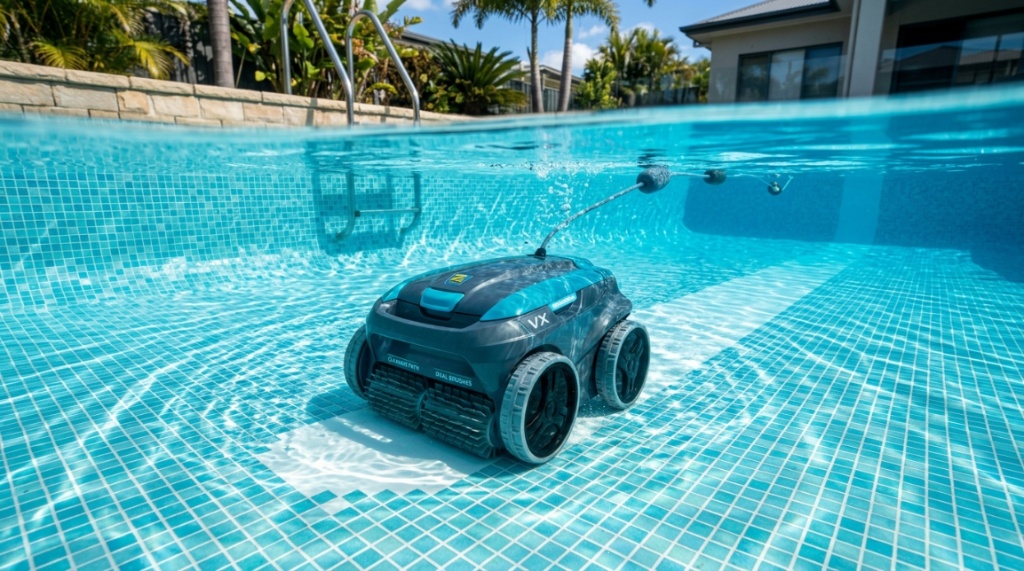
The primary benefit of a robotic cleaner is the reduction of time and effort. Traditional vacuuming requires you to manually maneuver a pole and vacuum head around the pool floor for 45 minutes to an hour. Even then, you often miss spots or struggle with the waterline algae. A robotic unit eliminates this manual work entirely.
But the benefits go beyond just saving time. They also contribute to a healthier pool environment. Because the robot scrubs the walls and floor with dedicated brushes, it actively prevents algae from taking hold. It also polishes the water by filtering out particles as small as 2 microns—far finer than most sand or cartridge filters in standard pool systems. This results in crystal-clear water that is gentler on your eyes and skin.
The “Set It and Forget It” Factor
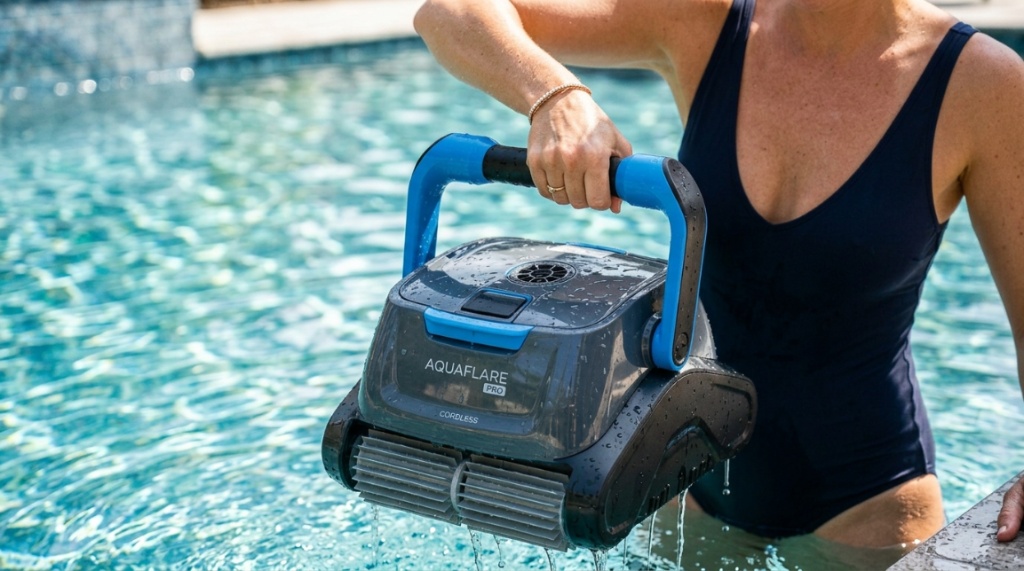
Think about your weekly routine. With a robot, you simply drop the unit into the pool and let it run for 1.5 to 3 hours. During this time, the machine climbs walls, scrubs the tile line, and vacuums the floor. When it finishes (or when the battery runs out), you pull it out using the handle, unzip the filter cartridge, and spray it clean. For cordless models, you do not even have to untangle a power cable.
This convenience is transformative for families or professionals who don’t have time to spend an hour a day on pool upkeep. It turns a chore into a passive task that happens while you are at work, sleeping, or enjoying the pool from the patio.
Key Technologies That Drive the Ease of Use
Modern robotic cleaners are marvels of engineering. They aren’t just random motors in a plastic shell; they utilize sophisticated technology to maximize efficiency. Understanding these features helps you know exactly why they make life easier and what you should look for when purchasing.
Smart Navigation and AI Vision
Older robotic models used a random pattern, bumping around like a blind beetle until they eventually covered the floor. While they worked, they wasted time. Today, high-end models use gyroscopes and accelerometers to follow logical rows. The latest advancement is AI Vision technology. This uses an onboard camera to “see” the pool walls and obstacles, mapping the most efficient cleaning path. This ensures the entire pool is cleaned in the first cycle, eliminating the need for a second run and saving battery life.
For example, a robotic cleaner with AI vision will recognize the waterline, the shallow end, and the deep end. It will systematically clean the waterline first, then the walls, and finish with the floor, ensuring no debris is left behind.
Cordless vs. Corded Options
One of the biggest ease-of-use factors is whether you choose a cordless or corded model.
- Cordless Models: These operate on internal lithium-ion batteries. They offer the ultimate in convenience because there is no tangled cable to deal with. You simply charge the unit, drop it in, and retrieve it when it’s done. Ideal for pools that are far from electrical outlets or for users who want a minimalist setup.
- Corded Models: These have a longer run time and typically offer more suction power since they are continuously powered. They are excellent for very large pools. Most have a swivel cable to prevent tangling, and the cable floats to keep it out of the way.
Brush Technology and Filtration Systems
Robotic cleaners use either brush rollers or suction-only inlets. Dual brush rollers are generally more effective because they agitate dirt and algae off surfaces before vacuuming it up. Many models offer different brush types for different surfaces—for example, softer brushes for tile and vinyl, and stiffer PVC brushes for concrete and plaster.
The filtration system also matters. Look for cleaners with large filter canisters or fine mesh filters. The larger the capacity, the less often you need to empty it. The ease of cleaning the filter is critical; models that offer a “quick-release” filter basket are much easier to rinse clean than those requiring you to unscrew complex parts,For more great ways to get your backyard ready for entertaining, check out our guide on how to plan a perfect family BBQ at home.
Step-by-Step: How to Use a Robotic Pool Cleaner
If you have never used one before, the process is refreshingly simple. Once you get the hang of it, the entire maintenance flow takes less than 15 minutes of your time on cleaning days.
- Remove the unit from its caddy and place it near the pool edge.
- Connect the power supply or ensure the battery is charged. If it is corded, unroll the cable and plug it into the transformer.
- Submerge the robot into the water. Hold it underwater at an angle until you see air bubbles stop escaping, ensuring the motor is primed.
- Press the start button or launch the app. The robot will immediately begin its cleaning cycle.
- Let it run. Do not stand in the water or obstruct its path.
- Retrieve the robot. When the cycle is complete or the battery is low, pull it out using the floating handle. Do not leave it in the pool indefinitely.
- Clean the filters. Open the top hatch, remove the cartridges, and spray them with a garden hose to remove debris.
- Rinse the robot with clean water and store it on its caddy away from direct sunlight.
Common Mistakes to Avoid
Even with simple technology, users make errors that reduce efficiency. Avoid these pitfalls to keep maintenance easy:
- Leaving it in the water: Constant exposure to chlorine and chemicals can degrade seals and brushes. Remove it after each cycle.
- Neglecting the filters: Clogged filters reduce suction. Clean them after every use.
- Dragging the robot: Always use the handle and caddy wheels. Dragging it across concrete will wear out the tracks.
- Ignoring the “waterline” feature: Make sure your model actually reaches the waterline; some cheaper models only clean the floor.
Is a Robotic Pool Cleaner Worth the Investment?
The biggest barrier to entry for robotic cleaners has historically been the upfront price tag. They are significantly more expensive than a basic hose vacuum. However, it is essential to look at the total cost of ownership and the value of your time.
While it may cost more upfront, a robot saves money over time through reduced energy consumption. Because they have their own motors, they operate on just a few hundred watts compared to the 1,500+ watt main pump that would otherwise have to run for hours. Additionally, by agitating and filtering the water so thoroughly, you reduce the amount of chlorine and algaecides needed, saving you money on chemicals.
Furthermore, consider the cost of your time. If you value the hour you spend every weekend scrubbing, the robot pays for itself in a single season. You are purchasing convenience and health, not just a vacuum.
What Should You Look For in a Quality Unit?
To ensure you get the easiest experience, look for these non-negotiable features:
- Self-Parking: This allows the unit to climb to the waterline and stop there so you can easily grab it, or it returns to the edge of the pool where you can hook it with a pole.
- Fine Filtration: Ensure the filter captures particles below 10 microns for optimal water clarity.
- High Quality Brushes: Look for abrasion-resistant brushes that can handle your pool surface type.
- Warranty and Support: Buy from a reputable brand that offers at least a 2-year warranty.
Frequently Asked Questions
How long do robotic pool cleaners last?
Most high-quality robotic pool cleaners have a lifespan of 5 to 7 years with proper maintenance. The key is to keep them out of the sun when not in use, clean the filters regularly, and replace worn brushes or tracks when needed to extend the life of the motor.
Do robotic pool cleaners clean the waterline?
Yes, most modern robotic cleaners are designed to climb the walls and clean the waterline tile. They use a combination of water jets and scrubbing brushes to remove scum lines and algae. If waterline cleaning is your top priority, ensure you choose a model that specifically advertises this capability.
Can a robot climb walls and clean stairs?
Yes, models with dual motors and good traction are excellent at climbing vertical walls and steps. However, no robot can clean behind ladders or inside tight corners perfectly. For the most accurate claims, look for models with special “stairs” settings that slow the robot down to ensure it navigates steps safely.
How often should you run a robotic pool cleaner?
For optimal maintenance, you can run the robot daily in heavy-use summer months, but running it 2 to 3 times a week is usually sufficient. Running it more often is actually better for your water chemistry, as it continuously filters out organic matter before it can break down and create chloramines.
Do robotic cleaners require a booster pump?
No. This is one of the main advantages of a robotic cleaner. It has its own internal electric motor and pump. It only requires a standard electrical outlet for the power supply (or a battery charge). You do not need to modify your plumbing at all.
Will a robot work with a solar cover on the pool?
Usually, no. You should remove the solar cover before running the robot. If the cover is left on, the robot cannot navigate the surface properly, and the cover can get tangled in the robot’s tracks or cable. It is best to run the robot in the morning before placing the cover back on.
Conclusion
Robotic pool cleaners have revolutionized pool maintenance, transforming a labor-intensive chore into a hands-free, automated process. By operating independently of your pool’s pump and filtration system, they save energy, reduce chemical usage, and capture debris more effectively than any manual method. Whether you choose a smart navigation system or a simple random-pattern machine, the convenience of pressing a button and walking away is undeniable. If you want to spend less time maintaining your pool and more time enjoying it, investing in a self-contained robot is the most effective decision you can make this season. Take the plunge and let the technology do the heavy lifting for you.