It is 6:30 a.m., and you are steaming a batch of sweet potatoes while simultaneously chopping raw chicken for tonight’s dinner. You rinse the cutting board, wipe the knife, and move on—but a lingering question stays with you: did that quick rinse actually make the board safe for your baby’s food? Cross-contamination is one of the most overlooked risks in home food preparation, and it matters even more when you are preparing food for an infant whose immune system is still developing. For parents who also want efficient tools for the job, knowing where to find the best baby puree makers in Illinois can simplify the equipment side of things—but the safety habits in this guide are what truly protect your baby’s food.
Quick Answer
Prevent cross-contamination by separating raw and ready-to-eat foods at every stage: use separate cutting boards and utensils, wash hands and surfaces with hot soapy water between tasks, sanitize equipment after contact with raw meat or eggs, and refrigerate prepared baby food within two hours. The biggest risk is not visible dirt—it is invisible bacteria transferred from raw ingredients, hands, or countertops to food your baby will eat without further cooking.
Key Takeaways
- Raw meat, poultry, eggs, and unwashed produce are the primary sources of contamination; keep them physically separated from cooked or ready-to-eat baby food.
- Rinsing a cutting board with water is not enough—use hot soapy water, and sanitize with a diluted bleach solution or dishwasher cycle after raw meat contact.
- Your hands are the most common transfer route; wash them for at least 20 seconds before and after handling raw ingredients.
- Proper storage temperature and timing (refrigerate within two hours, use within recommended windows) prevent bacteria from multiplying in prepared purees.
- Cleaning your baby food maker thoroughly between batches—including removable parts and seals—matters as much as cleaning your countertop.
Understanding What Cross-Contamination Actually Means
Cross-contamination is the transfer of harmful bacteria, viruses, or allergens from one surface, food, or object to another. In a home kitchen, this usually happens indirectly—not because you touched raw chicken and then touched your baby’s spoon, but because of the dozen small moments in between: the knife you set down, the faucet handle you turned, the towel you wiped your hands on.
For babies, the stakes are higher. Infants have immature immune systems and produce less stomach acid than adults, making them more vulnerable to foodborne pathogens like Salmonella, E. coli, and Listeria. A small amount of bacteria that might not affect an adult could cause significant illness in a baby. This does not mean your kitchen needs to be sterile—it means the high-risk moments deserve deliberate attention.
The Three Main Transfer Routes
- Direct contact: Raw meat juices dripping onto ready-to-eat food in the refrigerator, or a contaminated knife touching cooked puree.
- Indirect surface transfer: Bacteria left on cutting boards, countertops, sink basins, or appliance handles.
- Hand and utensil transfer: Touching raw ingredients and then handling a spoon, bottle, or storage container without washing first.
Setting Up a Safe Baby Food Prep Station
You do not need a separate kitchen. You do need a system that keeps raw and ready-to-eat items from sharing space during the same session.
The most practical approach is to designate a specific area of your counter for baby food preparation and keep raw meat, poultry, and eggs on the opposite side. If your kitchen is small, work in sequence rather than simultaneously: prepare all raw ingredients first, clean thoroughly, then prepare baby food. This “raw first, clean second” workflow eliminates the most common contamination window.
Equipment Worth Having
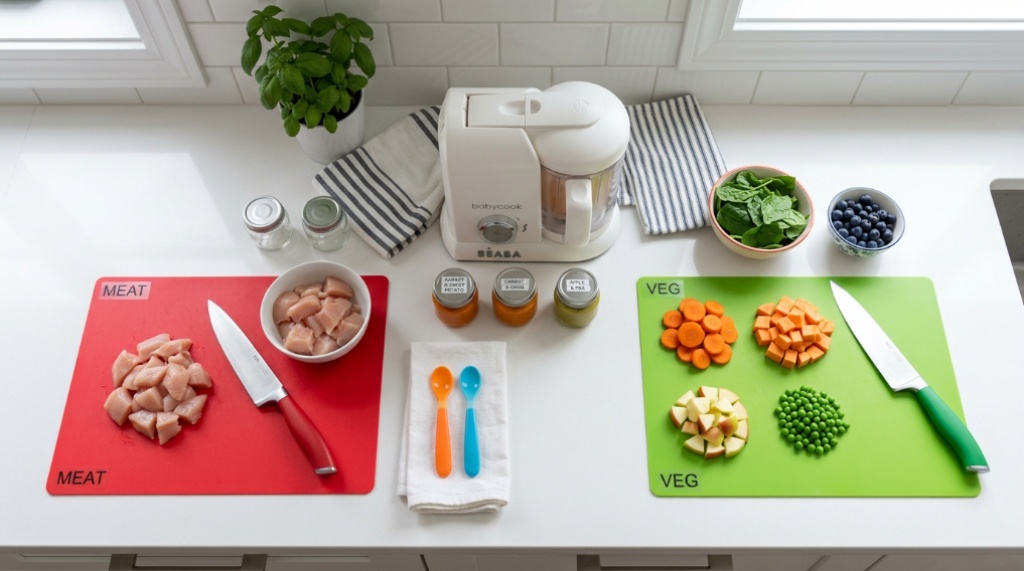
- Two cutting boards in different colors: one dedicated to raw meat and one for produce and cooked foods. Color-coding removes guesswork.
- A dedicated baby food prep spoon and set of knives that do not touch raw meat.
- Paper towels instead of cloth towels for drying surfaces that contacted raw ingredients. Cloth towels can harbor bacteria and spread them across multiple surfaces.
- A spray bottle of diluted bleach solution (typically about one tablespoon of unscented household bleach per gallon of water) for sanitizing counters and boards after raw meat contact.
If you use a baby food maker or steamer-blender, check whether its removable parts are dishwasher-safe. Many are, and a full dishwasher cycle with heated drying provides more consistent sanitization than hand washing alone. Parts that cannot go in the dishwasher—motor bases, seals, and some gaskets—need careful hand washing with hot soapy water, especially in crevices where puree residue collects.
A Step-by-Step Safe Prep Routine
Following a consistent sequence reduces the chance of forgetting a step when you are tired or distracted.
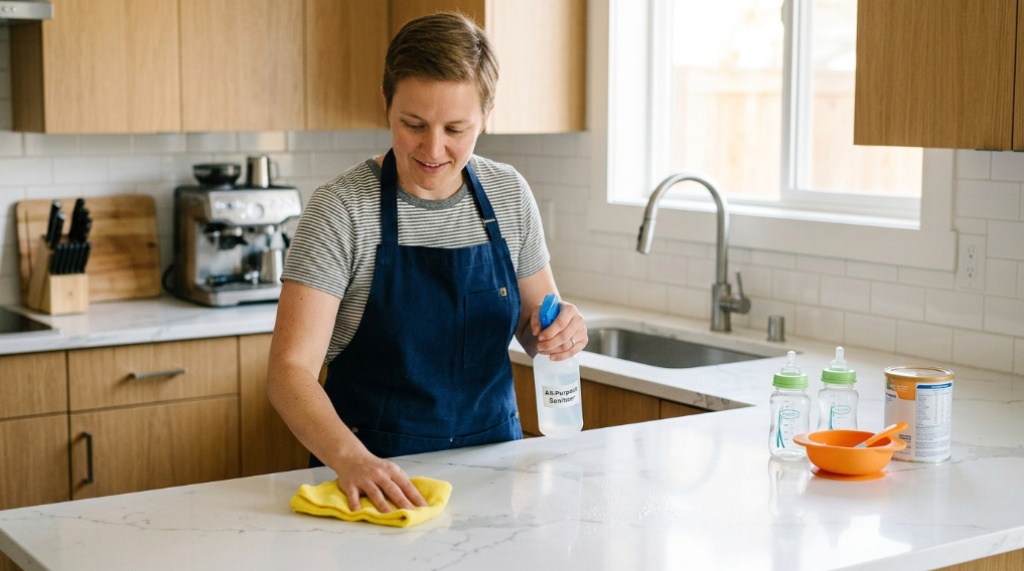
- Clear and clean the workspace. Remove clutter, then wipe the counter with hot soapy water. If you handled raw meat on it previously, follow with a sanitizing spray.
- Wash your hands for 20 seconds with warm water and soap. Dry with a paper towel.
- Gather all equipment first. Knives, boards, steamer basket, blender, storage containers. This prevents you from touching drawer handles and cabinet doors with contaminated hands mid-task.
- Wash and peel produce under running water. Even fruits you will peel—like bananas or avocados—should be rinsed, because bacteria on the skin transfer to the flesh when you cut through it.
- Prepare raw meat separately if it is part of the batch. Use the designated raw-meat board and knife. When finished, move the board directly to the sink and wash your hands before touching anything else.
- Cook or steam ingredients thoroughly. Heat kills bacteria, but only if the food reaches a safe internal temperature. For baby food, steaming until soft typically achieves this.
- Blend and portion using clean equipment. Avoid tasting the puree with the same spoon you will use to feed your baby unless you wash it first.
- Cool and refrigerate promptly. Do not leave puree sitting on the counter for more than two hours total, Before setting up your kitchen and purchasing the necessary tools for infant meal preparation, make sure you know How to Find the Right Equipment Supplier for Your Industry to guarantee high hygiene and safety standards.
Cleaning and Sanitizing: What Actually Works
There is a meaningful difference between cleaning and sanitizing. Cleaning removes visible debris and a portion of bacteria. Sanitizing reduces remaining bacteria to a level considered safe by public health standards. You need both, especially after contact with raw animal products.
| Surface or Item | Cleaning Method | When to Sanitize |
|---|---|---|
| Cutting boards (plastic) | Hot soapy water, scrub both sides | After every raw meat, poultry, or egg contact; dishwasher-safe boards can go in the dishwasher |
| Countertops | Hot soapy water wipe-down | After raw meat contact, or at the end of each prep session |
| Knives and utensils | Hot soapy water, scrub handles and blades | After raw meat contact; before switching to ready-to-eat foods |
| Baby food maker parts | Follow manufacturer instructions; most removable parts are hand- or dishwasher-washable | After each use, particularly after blending protein-rich ingredients |
| Sink basin | Scrub with soapy water | After washing raw meat or produce; sinks are a common hidden reservoir |
| Sponges | Replace frequently; microwave damp sponges briefly or run through dishwasher | Sponges harbor bacteria; consider using paper towels for raw meat cleanup |
One frequently overlooked item is the refrigerator. Raw meat stored on a shelf above prepared baby food can drip downward. Store raw meat on the bottom shelf in a sealed container or on a plate with a rim, and keep prepared purees on upper shelves or in a dedicated drawer.
Storage Practices That Prevent Contamination After Cooking
Contamination risk does not end when the puree is cooked. How you store, cool, and reheat baby food determines whether bacteria get a chance to multiply.
Cool purees quickly before refrigerating—spread them in a shallow container rather than a deep one, or place the container in an ice bath. Bacteria multiply most rapidly between 40°F and 140°F, so the goal is to move food through that range as quickly as possible. Once cooled, refrigerate in small portions.
Storage Timing Guidelines
- Refrigerator: Most homemade baby purees keep for about 48 to 72 hours. If you will not use them within that window, freeze them.
- Freezer: Purees stored in airtight containers or ice cube trays typically keep for one to three months, though quality declines over time.
- Thawing: Thaw in the refrigerator, not on the counter. Once thawed, use within 24 hours and do not refreeze.
- Reheating: Reheat only the portion you will use. Do not reheat the entire container, because saliva from a partially eaten spoon can introduce bacteria.
Label every container with the date and contents. This is not just organization—it prevents you from unknowingly using a puree that has been in the back of the fridge for a week.
Common Mistakes That Undermine Your Efforts
Even careful parents make these errors, usually because they seem harmless.
- Relying on a quick rinse. Water alone does not remove the biofilm that bacteria form on cutting board surfaces. Soap and friction are required.
- Using the same towel for everything. A towel used to dry hands after handling raw meat, then used to wipe a bowl, transfers bacteria directly.
- Tasting from the serving spoon. Your mouth carries bacteria that can contaminate the entire batch. Use a separate spoon for tasting, or wash the spoon before it goes back in.
- Letting puree cool too long on the counter. “Letting it cool completely” often means two or three hours at room temperature—enough time for bacteria to multiply significantly.
- Neglecting appliance seals and gaskets. Puree residue trapped in a blender gasket can harbor bacteria across multiple uses, even if the visible parts look clean.
- Storing raw and cooked foods together. Even sealed containers can leak. Keep them physically separated in the refrigerator.
Special Considerations for Baby Food Makers
Baby food makers—steamer-blender combos and dedicated puree appliances—simplify preparation but introduce specific cleaning responsibilities. Steam alone does not sanitize the entire appliance. Residue in the steaming reservoir, blending chamber, and seals can become a bacterial reservoir if not cleaned after each use.
After each batch, disassemble the removable parts and wash them in hot soapy water or place them in the dishwasher if the manufacturer allows it. Pay attention to the underside of blades and the area around the motor shaft, where puree often collects unnoticed. Let all parts air-dry completely before reassembling, because moisture trapped in a sealed appliance encourages mold and bacterial growth.
If you prepare multiple batches in one session—say, sweet potato for the week and chicken puree for freezing—clean the appliance between different food types, especially after raw or minimally cooked proteins. This prevents flavor transfer and, more importantly, prevents any bacteria from the protein batch from surviving into the next batch.
Frequently Asked Questions
Can I use the same cutting board for fruits and vegetables?
Yes, if the board has been washed with hot soapy water since its last contact with raw meat. Produce should still be washed under running water before cutting, even if you plan to peel it, because bacteria on the skin can transfer to the flesh during cutting.
How long can homemade baby puree sit at room temperature?
No more than two hours total, including preparation and cooling time. After two hours, bacteria can multiply to levels that may cause illness, especially in infants. Cool purees quickly using shallow containers or an ice bath, then refrigerate or freeze promptly.
Is it safe to reheat baby food more than once?
No. Reheat only the portion you will feed your baby in that sitting. Repeated reheating cycles increase the time food spends in the temperature danger zone and raise the risk of bacterial growth. Discard any puree that has been reheated and not eaten.
Do I need to sanitize bottles and spoons after every use?
For healthy, full-term babies, thorough washing with hot soapy water is generally sufficient for daily use. Sanitizing—by boiling, steaming, or using a dishwasher’s sanitize cycle—is especially important for newborns, premature infants, or babies with compromised immune systems, and for any items that contacted raw food or illness.
Can cross-contamination cause allergic reactions?
Yes. If your baby has a known allergy, even trace amounts of an allergen transferred from a utensil, board, or appliance can trigger a reaction. If you prepare food containing a common allergen like peanut, egg, or dairy, wash all equipment thoroughly before preparing allergen-free food for the same baby.
Does freezing baby food kill bacteria?
No. Freezing pauses bacterial growth but does not kill bacteria. This is why safe handling before freezing matters—if bacteria are present when the puree goes into the freezer, they will still be there when it thaws.
Conclusion
Preventing cross-contamination in baby food comes down to a few consistent habits: separate raw and ready-to-eat foods, wash hands and surfaces thoroughly with soap, sanitize after raw meat contact, and refrigerate prepared purees within two hours. The appliances and tools you use matter, but the routine you follow matters more. Build these steps into your preparation process until they become automatic, and you will remove the most common pathways that let bacteria reach your baby’s food. Start with one change—a dedicated cutting board or a stricter handwashing habit—and expand from there.