
You step up to the tee, address the ball, and begin your swing. But halfway through, you feel your foot slip, your weight shifts, and your shot slices into the rough. Sound familiar? The root cause isn’t your technique—it’s your footwear. Most golfers underestimate how much their shoes influence every shot.
If you struggle with an inconsistent swing or feel wobbly during your downswing, you need to focus on golf shoes stability balance. This guide will walk you through exactly what to look for, so you can stay grounded, swing harder, and shoot lower scores.
Why Does Stability Matter More Than Comfort in Golf Shoes?
Stability matters more than comfort because your feet are the only connection to the ground during your swing. Without a stable base, your body compensates with poor mechanics, leading to inconsistent contact and reduced power. Comfort is important for 18 holes, but stability is non-negotiable for every single swing.
When you generate torque during your backswing and downswing, your feet experience lateral forces that can cause slipping. A stable shoe keeps your foot planted, allowing your hips to rotate fully without your body swaying. This directly translates to better weight transfer and a more repeatable swing path. Think of stability as the foundation of a house—if it shifts, everything above it crumbles.
The Physics of Balance in Golf
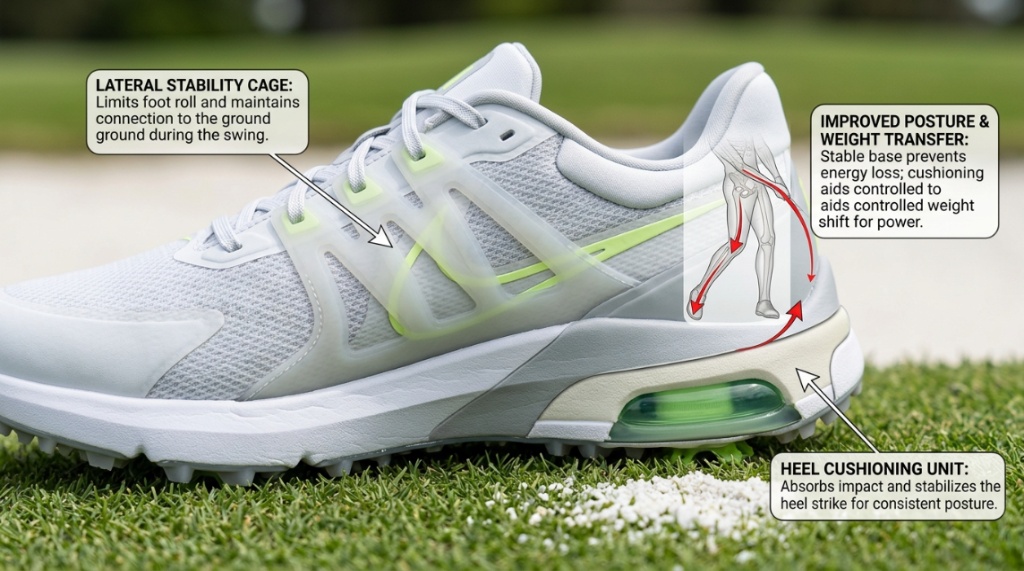
During a golf swing, your center of gravity moves from the inside of your back foot to the outside of your front foot. A stable shoe provides a platform that resists these shifts. Without it, your brain instinctively holds back to prevent falling, robbing you of power and accuracy.
What Key Features Create Stability and Balance in Golf Shoes?
Four key features create stability and balance: a rigid outsole, lateral support structures, a firm heel cup, and a low-to-ground platform. Each feature works together to lock your foot in place and prevent unwanted movement during your swing.
Let’s break down each feature so you can inspect any shoe with confidence.
Outsole Rigidity and Traction
The outsole is the bottom of the shoe that contacts the ground. For stability, you need a rigid outsole that resists twisting. If you can easily twist the shoe in your hands, it offers poor stability. Look for outsoles made from TPU (thermoplastic polyurethane) or nylon blends. These materials provide torsional rigidity without adding excessive weight.
Traction is equally important. Spiked outsoles (either traditional cleats or hybrid spikeless designs) offer superior grip compared to completely spikeless shoes. The spikes dig into the turf and prevent lateral sliding during your swing.
Lateral Support and Heel Counter
Lateral support prevents your foot from rolling over the edge of the shoe during your downswing. This is often achieved with a wider outsole flare and stiffer sidewalls. The heel counter—the rigid cup at the back of the shoe—holds your heel in place. A loose heel causes instability because your foot shifts inside the shoe, even if the outsole stays put.
Platform Height
Shoes with a lower platform height bring your foot closer to the ground. This lowers your center of gravity and improves proprioception—your brain’s ability to sense where your body is in space. Avoid overly cushioned, “athletic-style” golf shoes that lift your foot too high off the ground.
Which Outsole Type Is Best for Balance: Spiked or Spikeless?
Spiked outsoles are best for maximum balance and stability, especially on wet grass or hilly terrain. Spikeless shoes offer versatility and comfort but sacrifice some grip and lateral stability. Your choice depends on where you typically play.
| Feature | Spiked (Cleated) | Spikeless |
|---|---|---|
| Grip on wet turf | Excellent | Good |
| Lateral stability | Superior | Moderate |
| Walking comfort | Fair | Excellent |
| Versatility (clubhouse to course) | Low | High |
| Best for | Competitive play, hilly courses | Casual rounds, flat courses |
If you prioritize stability above all else, choose spiked shoes with at least six cleats per shoe. Many modern spiked shoes use soft spikes that don’t damage greens but still provide exceptional traction. Spikeless shoes work well for beginners or players who walk on paved paths between holes, but they won’t offer the same locked-in feel as spikes.
How Does the Shoe Width and Fit Affect Your Swing Stability?
Shoe width and fit directly affect stability by controlling how much your foot moves inside the shoe. A snug fit through the midfoot and heel prevents internal slipping, while adequate toe room allows for natural foot expansion during your swing.
Many golfers wear shoes that are too wide or too narrow. A shoe that is too wide allows your foot to slide laterally during rotation. A shoe that is too narrow causes arch cramping and restricts natural weight shift. Both scenarios reduce stability.
Finding Your Ideal Width
Most golf brands offer widths from narrow to extra wide. To find your fit, follow these steps:
- Measure your feet at the end of the day when they are slightly swollen.
- Wear your golf socks during fitting, as they are thicker than casual socks.
- Check the heel lock—your heel should not lift more than a quarter-inch when you walk.
- Test lateral movement—stand on one foot and shift your weight side to side. Your foot should not slide across the insole.
Can Cushioning Improve or Hurt Your Balance?
Cushioning can hurt your balance if it is too soft or thick. Excessive cushioning creates an unstable platform, similar to standing on a pillow. Your foot sinks into the foam, and your body struggles to maintain a solid base. Moderate, firm cushioning provides enough shock absorption for walking without compromising stability.
Look for shoes with dual-density midsoles. The outer layer is soft for comfort, while the inner layer is firm for support. Avoid “max cushion” models designed for running. Golf shoes should have a firmer, more responsive feel.
Pros and Cons of Different Cushioning Types
- EVA foam: Lightweight and comfortable, but compresses over time. Best for casual players.
- Polyurethane (PU): Denser and more durable. Provides better stability than EVA.
- Boost or gel inserts: Excellent energy return, but can feel unstable during rotational swings. Use sparingly.
What Role Does the Upper Material Play in Providing Support?
The upper material provides support by wrapping your foot securely and resisting stretch over time. Leather and synthetic leather uppers offer the best stability because they maintain their shape. Knit or mesh uppers are lighter and more breathable but stretch out, reducing lateral support.
For maximum stability, choose a shoe with a full-grain leather or synthetic leather upper reinforced with overlays in the midfoot and heel. These materials prevent your foot from breaking out of the shoe during aggressive swings. If you prefer knit uppers for breathability, look for models that integrate TPU or plastic support cages around the heel and arch.
How to Test Golf Shoe Stability Before You Buy
You can test golf shoe stability in-store or at home with three simple checks. These exercises reveal how a shoe will perform during your actual swing.
- The Twist Test: Hold the shoe by the toe and heel. Try to twist it. A stable shoe resists twisting. If it twists easily, it offers poor torsional rigidity.
- The Heel Squeeze: Press the heel counter with your thumb. It should be firm and not collapse inward. A soft heel counter indicates poor heel lock.
- The Lateral Rock Test: Place the shoe on a flat surface and push against the side of the outsole. The shoe should resist tipping. This simulates the lateral force during your downswing.
If a shoe passes all three tests, it will almost certainly improve your balance on the course.
Which Brands Prioritize Stability and Balance in Their Designs?
Several brands engineer their shoes specifically for stability. FootJoy, Ecco, and New Balance lead the category with dedicated stability models. FootJoy’s Tour Alpha series features a rigid carbon fiber plate. Ecco’s BIOM technology uses a natural last that supports the foot’s anatomy. New Balance offers wider fits and firmer midsoles in their Striker series.
When shopping, look for terms like “stability frame,” “torsion control,” or “wider platform” in product descriptions. Avoid models marketed solely for “ultra-lightweight” or “maximum cushioning,” as these often compromise stability for comfort or weight savings.
Budget-Friendly Stability Options
You don’t need to spend top dollar for solid stability. Several affordable models include the same rigid outsoles and support features as premium shoes. For example, the golf shoes stability balance found in mid-range brands like Skechers and PUMA offer excellent performance without breaking the bank. These shoes often use hybrid outsoles with strategic spike placement and firm foam midsoles.
When Should You Replace Your Golf Shoes for Optimal Stability?
You should replace your golf shoes every 12 to 18 months or after 50 to 75 rounds, whichever comes first. Worn spikes and compressed midsoles gradually reduce stability, often without you noticing. Using old shoes leads to subtle compensations in your swing that become hard to fix.
Signs it’s time to replace:
- Spikes are worn down to less than half their original height.
- The outsole feels smooth or slippery on hard floors.
- You notice your foot hurts more after rounds, particularly the arches or heels.
- The upper has visible creasing or doesn’t hold its shape.
How Do Course Conditions Influence Your Shoe Choice?
Course conditions heavily influence your shoe choice. Wet, soft, or hilly courses demand maximum traction and stability. Dry, flat, or firm courses allow for more flexibility with spikeless designs.
Match your shoe to your primary playing conditions:
- Wet conditions: Spiked shoes with large treads and waterproof membranes.
- Hilly terrain: Wide base shoes with aggressive lateral support and heel counters.
- Dry, flat courses: Spikeless or hybrid shoes with moderate stability features.
- Walking-only courses: Firm cushioning with durable traction.
If you play a mix of conditions, invest in spiked shoes with replaceable cleats. This gives you the flexibility to swap spikes when they wear out or when conditions change.
Frequently Asked Questions
Can I use running shoes for golf to improve balance?
No. Running shoes are designed for forward motion and have soft, unstable heels. They lack the lateral support and rigid outsole needed for a golf swing. Using them increases your risk of slipping and developing swing compensations.
Do golf shoes with BOA laces improve stability?
BOA laces can improve stability because they allow for a more precise, evenly distributed fit. A dial system eliminates loose spots that traditional laces can create. This helps lock your heel in place more effectively.
Is waterproofing important for stability?
Waterproofing is important for stability because wet feet can slip inside the shoe. A waterproof membrane keeps your socks dry, which reduces friction and prevents blisters. Dry feet stay locked in place better than wet feet.
Should I buy golf shoes half a size larger for stability?
No, you should not buy larger sizes for stability. A larger shoe allows your foot to slide, which decreases stability. Buy your true size or half a size smaller if you are between sizes. Focus on width, not length, for a better fit.
Do foot orthotics help with balance in golf shoes?
Yes, custom or over-the-counter orthotics can improve balance if you have flat feet or high arches. They fill the space inside the shoe and provide a more stable platform. However, ensure your shoe has a removable insole to accommodate orthotics.
How important is ankle height for stability?
Ankle height is less important than outsole width and heel cup support. Most golf shoes are low-top, which is fine for stability. High-top golf shoes exist but are not necessary for most players. A firm heel counter does more for stability than a taller collar.
Can spikeless shoes be stable enough for competitive play?
Yes, modern spikeless shoes from brands like FootJoy and Ecco offer competitive stability, especially on dry courses. However, for wet conditions or aggressive swingers, spiked shoes still provide superior grip and lateral stability.
When you watch the world’s best players compete across The Four Major Golf Tournaments, you will notice their footwear changes based on the course conditions. Selecting the right traction pattern ensures your feet stay locked to the turf no matter how slick the fairway gets.
Conclusion
Choosing golf shoes that improve stability and balance is one of the most impactful equipment decisions you can make. Focus on rigid outsoles, firm heel cups, lateral support, and a snug fit. Avoid overly cushioned or stretched-out shoes that compromise your foundation. Test your shoes in-store using the twist, heel squeeze, and lateral rock tests. Match your shoe type to your course conditions for maximum performance. Your swing depends on a solid base—invest in shoes that keep you grounded. Review the golf shoes stability balance options available today and replace any pair that fails to support your game.