

You just bought a baby walker, and three months later, your little one has already outgrown it. Frustrating, right? Many parents face this exact problem, watching a perfectly good piece of baby gear gather dust simply because it couldn’t adapt. The solution lies in choosing a convertible model designed for extended use. A 3 in 1 baby walker infant walker eliminates this issue by transforming from a traditional walker into a sit-to-stand activity center and eventually a push-along toy. This guide walks you through exactly what to look for so you can make one smart purchase that lasts from those first wobbly steps through toddlerhood.
What Exactly is a 3 in 1 Baby Walker Infant Walker?
A 3 in 1 baby walker infant walker is a multi-stage developmental toy that converts between three distinct modes: a seated walker with wheels, a stationary activity station, and a push-behind walker for toddlers who are already walking. It is designed to adapt as your child grows, typically supporting children from around 4 months up to 2 or 3 years old.
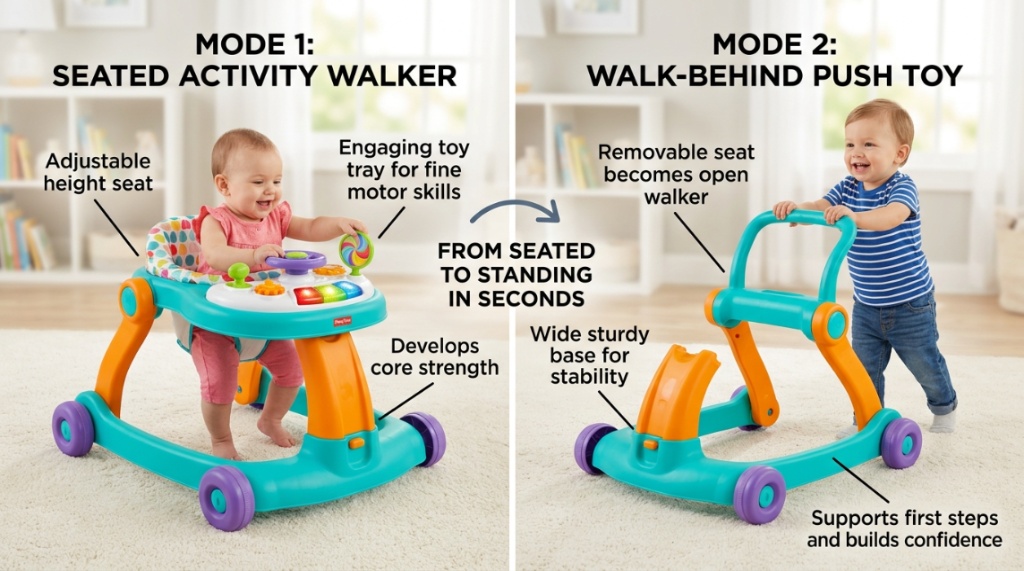
Unlike traditional one-purpose walkers, these convertible units feature detachable trays, adjustable height settings, and removable toy panels. In the first stage, the baby sits in the seat and uses their feet to scoot around. Once your child begins pulling up to stand, you remove the seat frame, transforming the unit into a sturdy activity center. Finally, when your toddler gains confidence walking, the toy tray converts into a handlebar for a push walker that encourages balance and stride.
This three-stage design means you are not buying new gear every few months. It saves money, reduces clutter, and provides consistent developmental support through critical growth phases.
Why Should You Choose a Convertible Walker Instead of a Standard One?
A standard baby walker serves one purpose: letting a pre-walking baby move around in a seated position. A convertible walker serves three distinct purposes, making it a significantly better investment for both your wallet and your child’s development.
Standard walkers are often used for only 2 to 4 months before the baby outgrows them. During that short window, the baby can only use it in one way. Once they start walking, the walker becomes useless. Convertible models, by contrast, are designed with modular components that you reconfigure as your child hits new milestones. You get a walker, a stationary play station, and a push walker all in one package.
From a developmental perspective, convertible walkers also encourage a wider range of movements. The stationary mode helps strengthen leg muscles without encouraging the potentially unsafe scooting motion that traditional walkers promote. The push mode helps toddlers practice upright walking with support, which builds confidence and balance.
The Financial Argument
- Standard walker: $40–$70 (used for 2–4 months)
- Push walker: $25–$45 (used for 4–8 months)
- Activity center: $30–$60 (used for 3–6 months)
- Total for three separate items: $95–$175
- 3 in 1 convertible walker: $60–$110 (used for 18–24 months)
Choosing a convertible model saves you between $35 and $65 while also reducing the number of bulky items taking up space in your home.
How Does a 3 in 1 Baby Walker Support Different Developmental Stages?
A 3 in 1 baby walker infant walker supports your child through three distinct developmental stages: the scooting phase, the pulling-up phase, and the walking phase. Each mode targets specific motor skills and muscle groups appropriate for that stage.
Stage 1: The Seated Walker (Around 4–8 Months)
In this stage, your baby sits inside the walker frame and uses their feet to push themselves around. This mode helps develop gross motor skills, leg strength, and spatial awareness. The seat provides trunk support while allowing free leg movement. Most models offer two to three height adjustments so you can raise the seat as your child grows taller.
Stage 2: The Activity Station (Around 6–12 Months)
Once your baby can sit independently and pull themselves up to stand, you remove the seat frame. The base becomes a stationary activity center with toys, lights, and sounds on the tray. Your child stands at the tray, supported by the sturdy frame, and plays with the interactive elements. This mode strengthens the leg muscles needed for walking and improves hand-eye coordination.
Stage 3: The Push Walker (Around 9–18 Months)
When your toddler is ready to take their first independent steps, the toy tray converts into a handlebar. The unit becomes a push walker that your child pushes in front of them. This mode helps with balance, coordination, and walking confidence. The wheels typically have speed controls or resistance mechanisms to prevent the walker from rolling too fast.
What Key Features Should You Look for When Buying One?
Not all convertible walkers are created equal. To ensure you get a safe, durable, and genuinely useful product, prioritize these features when shopping.
| Feature | Why It Matters | What to Look For |
|---|---|---|
| Height Adjustability | Accommodates growing children and maintains proper leg positioning | At least 3 adjustable height settings on the seat |
| Wheel Resistance | Prevents runaway rolling and keeps baby safe | Grip rings, speed locks, or adjustable resistance wheels |
| Removable Toy Tray | Allows conversion between modes and easy cleaning | Tray that snaps off without tools; dishwasher-safe toys |
| Sturdy Base | Prevents tipping when child leans or pushes | Wide, weighted base with anti-slip feet for activity mode |
| Foldable Frame | Enables easy storage and portability | One-hand fold mechanism; compact storage size |
| Interactive Toys | Supports cognitive and sensory development | Lights, sounds, textures, and removable toy bar |
Which Type of Wheels Are Safest for a Growing Baby?
The safest wheels for a convertible baby walker are those that offer some form of resistance or speed control. Look for models with rubber grip rings around the wheels or mechanical speed locks that slow the walker down on different surfaces.
Standard plastic wheels on basic walkers allow the unit to roll too quickly, especially on hardwood or tile floors. This speed can cause a baby to tip forward or struggle to keep up. Convertible walkers designed for multi-stage use typically include more sophisticated wheel systems. Some models have two-wheel lock modes: one for full mobility in walker mode and one for restricted movement in push mode.
For push walker mode specifically, friction-based resistance is ideal. This means the wheels still roll, but they require more effort from your toddler. It prevents the walker from shooting out from under them and gives them time to practice balance. You should also ensure the wheels are wide enough to provide stability and that they do not collect hair or debris easily.
Wheel Comparison Table
- Plastic wheels without grip: Fast rolling, minimal friction, slippery on hard floors – least safe
- Plastic wheels with rubber grip rings: Moderate rolling speed, better traction, suitable for mixed flooring – good option
- Wheels with mechanical speed lock: Controlled rolling speed, adjustability, best for push walker mode – safest choice
- Foam-core wheels: Quiet, good grip, but may wear down faster – acceptable but not ideal
How Can You Ensure the Walker Is Safe for Your Child?
Safety starts with checking for JPMA (Juvenile Products Manufacturers Association) certification and ensuring the walker meets current ASTM F977 safety standards. These certifications indicate the product has been tested for stability, structural integrity, and hazard prevention.
Beyond certification, inspect these specific safety elements before purchase:
Tip-over prevention: The base must be wider than the seat frame. When your child leans forward or to the side, the base should keep the walker upright. Test this by gently pressing down on one side of the tray while the walker is empty. It should not lift the opposite wheels off the ground easily.
Seat belt or harness: A properly fitted three-point or five-point harness keeps your baby securely seated. Without it, babies can slide down or climb out. Always use the harness, even if your child protests.
No sharp edges or pinch points: Run your fingers along all seams, hinges, and connection points. The plastic should be smooth, and folding mechanisms should be shielded from little fingers.
Doorway clearance: The walker should be wider than standard doorways (about 36 inches). This prevents the walker from fitting through doorways where stairs or other hazards might be present.
When Is the Right Time to Transition Between Modes?
transition your child between walker modes when they show clear signs of readiness for the next stage. Pushing them too early can lead to frustration or improper muscle development.
Switch from seated walker to activity station when: Your baby can sit independently for several minutes without support and begins pulling themselves up on furniture. This usually happens around 6 to 8 months. If your baby’s legs are fully extended at the lowest seat setting, it is time to move up.
Switch from activity station to push walker when: Your toddler can stand unsupported for at least 10 seconds and has taken a few independent steps. This typically occurs between 9 and 12 months. You want your child to have some balance before introducing a push walker, as pushing a walker requires coordinated forward motion.
General rule: Watch for signs of discomfort or boredom in the current mode. If your child refuses to sit in the walker or seems frustrated trying to stand, attempt the transition. You can always switch back if they are not ready.
Can a 3 in 1 Walker Replace Other Baby Gear?
A 3 in 1 baby walker infant walker can replace a standard seated walker, a stationary play table, and a push walker, but it does not replace all baby gear. You will still need other items for specific developmental purposes.
What it replaces:
- Traditional seated walkers completely
- Stationary activity tables or exersaucers partially (if your child enjoys standing)
- Push walker toys completely
What it does not replace:
- Baby bouncers or swings (for soothing and containment)
- Jumperoos or door bouncers (for jumping motion)
- High chairs (for feeding)
- Playpens (for supervised independent play)
If you are looking to minimize gear clutter, the 3 in 1 walker is an excellent starting point. It consolidates three common items into one, freeing up floor space and simplifying your daily routine. For parents in apartments or smaller homes, this space-saving benefit alone makes the investment worthwhile.
How Do You Clean and Maintain a Convertible Walker?
Regular cleaning ensures the walker remains safe and hygienic for your child. Fortunately, most convertible walkers are designed with easy maintenance in mind.
Daily cleaning: Wipe down the tray and toys with a mild soap solution or baby-safe disinfectant wipes. Focus on areas where your child drools, spits up, or puts their mouth. For the seat pad, check if it is machine washable. Most are, but always confirm on the manufacturer’s label.
Weekly cleaning: Remove the toy tray entirely and wash it in warm, soapy water. Check the wheels for hair, lint, or debris that could affect rolling. Use a toothpick or small brush to clean wheel axles. Inspect all screws and bolts for loosening and tighten them with a screwdriver if needed.
Storage tips: When not in use, fold the walker flat and store it in a dry area. Avoid leaving it in direct sunlight for extended periods, as UV rays can fade plastic and weaken structural components. If storing for a future child, disassemble the toy tray and remove batteries from electronic elements to prevent corrosion.
What Are Common Mistakes Parents Make With Multi-Stage Walkers?
Avoiding these common pitfalls will help you get the most out of your convertible walker.
Mistake 1: Skipping height adjustments. Many parents set the seat once and forget about it. As your baby grows, their legs should have a slight bend when their feet touch the floor. If their legs are straight or they are on tiptoes, adjust the seat immediately. Proper positioning prevents awkward gait development.
Mistake 2: Forcing the push mode too early. Some parents rush to convert the walker because they want their child to walk faster. This backfires. A toddler who is not ready for the push mode will either refuse to use it or rely on it too heavily, delaying independent walking. Let them lead the transition.
Mistake 3: Ignoring wheel speed. Do not assume all wheels are safe on all surfaces. Test the walker on your specific flooring before letting your child use it freely. If the walker rolls too fast on hardwood, look for models with speed resistance switches or add wheel grip covers.
Mistake 4: Over-relying on the walker. Even with a convertible design, your child still needs plenty of floor time for crawling, rolling, and tummy time. Walkers are a supplement to development, not a substitute for natural movement exploration.
As your little one transitions from floor play to standing, their footwear and mobility tools work hand-in-hand. Before choosing a convertible walker, it is helpful to look at early milestones and ask, How Do Baby Shoes Influence Crawling Styles? to ensure proper foot development.”
Which Brands Offer the Best 3 in 1 Convertible Walkers?
Several reputable brands manufacture high-quality 3 in 1 baby walker infant walker models. While specific product availability changes, the following brands consistently receive positive reviews for durability, safety, and ease of conversion.
VTech: Known for interactive toys and educational content. Their models often include lights, sounds, and multiple language settings. The toy tray is usually removable and dishwasher-safe. VTech walkers tend to have good wheel resistance for push mode.
Baby Care: Specializes in foldable, space-saving designs. Their walkers often feature one-hand folding mechanisms and lightweight frames. The seat pads are typically machine washable, and the toys include sensory elements like crinkle paper and teethers.
Joovy: Offers premium models with larger trays and more legroom. Their walkers often have wider bases for added stability. Joovy prioritizes minimalistic designs with fewer but higher-quality toys. The wheels are typically larger and smoother-rolling than budget options.
Safety 1st: Provides reliable entry-level options with solid safety features. Their walkers are well-tested and budget-friendly. You may not get as many interactive toys, but the core function of safe multi-stage use is excellent.
For a curated list of top-rated models with detailed comparisons, check out this resource on 3 in 1 baby walker infant walker options that other parents recommend most.
Frequently Asked Questions
Is a 3 in 1 baby walker safe for hardwood floors?
Yes, most models are safe for hardwood floors if they have rubber grip rings or speed resistance wheels. The grip rings reduce rolling speed and prevent scratches. Always test the walker on your specific flooring before full use.
At what age can a baby start using a 3 in 1 walker?
Most convertible walkers are suitable from about 4 months in seated mode. Always check the manufacturer’s weight and age recommendations. Your baby should have good head control and be able to sit with minimal support before using the seated mode.
Can a 3 in 1 walker help my baby learn to walk faster?
No, walkers do not teach babies to walk faster. They provide practice opportunities but do not accelerate natural development. The push mode helps with balance and confidence, but every child reaches walking milestones at their own pace.
How do I clean the toy tray on a convertible walker?
Most toy trays are removable and can be washed in warm, soapy water or placed on the top rack of a dishwasher. Check the instruction manual first. For electronic toys, use a slightly damp cloth and avoid submerging them in water.
Are convertible walkers easy to travel with?
Many 3 in 1 walkers fold flat for storage and travel. Look for models with a one-hand fold mechanism and compact dimensions. Most weigh between 6 and 10 pounds, making them manageable for car trips or visits to grandparents.
Do I need to buy additional accessories for a 3 in 1 walker?
Generally, no. The walker includes everything you need for all three modes. Some parents purchase extra toy attachments, but these are optional. The included toy tray usually offers sufficient stimulation.
What should I do if my child outgrows the weight limit?
Stop using the walker immediately once your child exceeds the manufacturer’s weight limit (usually around 26 to 30 pounds). Continued use could cause the frame to fail or tip over. Consider transitioning to a toddler push toy designed for older children.
Conclusion
Finding a baby walker that grows with your child saves you money, reduces clutter, and provides consistent developmental support during those crucial early months. A 3 in 1 baby walker infant walker transforms from a seated walker to an activity station to a push walker, adapting to your child’s changing needs from around 4 months through toddlerhood. You no longer need to buy three separate pieces of gear that each get used for only a few months. Instead, you invest once in a well-designed, safe convertible model that supports your child’s journey from scooting to walking. Focus on height adjustability, wheel resistance, sturdy construction, and JPMA certification when making your choice. Your wallet and your floor space will thank you.
Ready to find the perfect model for your little one? Start your search with the top-rated convertible walkers and read real parent reviews to make an informed decision.