
Picture this: you’ve just set up a beautiful new tank, the water is crystal clear, and you’re ready to add your first fish. Then you realize your Florida room hits 85°F during the day but drops to 68°F at night. Your heater kicks on, struggles, and you worry about your electric bill. Sound familiar? Finding a reliable yet cheap aquarium heaters Florida solution is tricky because our warm climate creates unique challenges—oversizing, rapid temperature swings, and corrosion from humidity. The good news? You don’t need a $100 titanium heater to keep your tank stable. This guide breaks down exactly how to choose an affordable model that works with Florida’s tropical environment, not against it.
Why Do Florida Aquarists Need a Different Heater Strategy?
Unlike northern states that fight to keep tanks warm, Florida aquarists often need heaters primarily for nighttime temperature drops and during rare cold snaps. This changes the sizing math completely. A 50-watt heater might be plenty for a 20-gallon tank in Miami, while the same tank in Maine would need 100 watts. Oversizing here leads to rapid temperature spikes that stress fish.
Here’s the core issue: most heater guides assume a cold room temperature of 65°F. In Florida, your room might be 75°F most of the year. This means you can buy a lower wattage unit, which costs less upfront and runs less frequently, saving money on electricity. However, you need a heater with a reliable thermostat that can handle the occasional 20-degree temperature swing between day and night.
Understanding Florida’s Unique Temperature Fluctuations
During winter, a cold front can drop an unheated room to 55°F overnight. Your heater must be powerful enough to raise the water temperature by 20 degrees, but not so powerful that it overheats the tank when the room is already at 80°F. The solution is choosing a unit with a precise thermostat and a lower wattage rating than you’d typically use.
The Hidden Cost of Cheap Heaters in Humid Climates
Florida’s humidity is brutal on electronics. A cheap heater with exposed seams or thin glass can develop condensation inside, leading to short circuits or inaccurate temperature readings. Look for units with fully sealed, submersible designs and durable thick glass tubing. Spending $5 extra on a better sealed unit will save you from replacing it every six months.
How Room Temperature Affects Wattage Needs
Use this simple rule for Florida: for every gallon of water, you need 2.5 watts if your room stays above 70°F, and 3 watts if you keep your home at 68°F during winter. This is lower than the standard 5 watts per gallon rule. For a 20-gallon tank, that’s just 50 watts, not 100 watts. This saves you $15-20 on the initial purchase.
What Is the Best Type of Heater for Warm Climates?
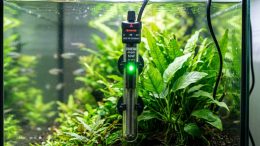
The best type for Florida is a fully submersible, adjustable, quartz glass heater with a separate temperature controller. Avoid pre-set heaters that heat to 78°F only. You need adjustable range from 68°F to 85°F. Quartz glass heats quickly and cools down fast, which is ideal for short heating bursts.
While titanium heaters are more durable, they are overkill for most Florida setups. A high-quality quartz glass heater with a plastic protective guard is your best value. The protective guard prevents fish from burning themselves, which is more common in warm climates because fish are more active.
Submersible vs. Hang-On Heaters: Which Works Better?
Submersible heaters are preferred for Florida because they maintain stable temperatures even during rapid ambient shifts. Hang-on heaters are less efficient and prone to overheating in warm rooms. Always choose fully submersible models. This ensures the thermostat reads the actual water temperature, not the warm room air.
Adjustable Thermostats Are Non-Negotiable for Florida
You need a heater that can be set to 75°F in summer and 80°F in winter. A preset heater will either overheat during summer months or underheat during a cold front. Adjustable models cost only $3-5 more than pre-set ones, but they provide essential control. Look for a dial with marked temperature increments.
Why Glass Heaters Are More Practical Than Titanium in Florida
Titanium heaters are bomb-proof, but they are also 3-4 times more expensive. In Florida, you don’t need that extreme durability because you’re not running the heater 24/7 year-round. A good glass heater will last 2-3 years if properly maintained. Save your money and invest in a good thermometer instead.
How to Calculate the Right Wattage for Your Tank Size
To calculate wattage for Florida, multiply your tank volume (in gallons) by 2.5 if your room temperature stays above 70°F, and by 3.0 for colder winter rooms. For a 40-gallon breeder tank in Orlando, that means 100 to 120 watts. This is significantly lower than the standard 200 watts recommended nationally.
A lower wattage heater costs less upfront, around $15 instead of $30, and consumes less energy. But you must ensure the heater is powerful enough to handle the worst-case winter scenario. If you live in North Florida near Jacksonville, use the 3.0 multiplier. South Florida residents can use 2.0.
Wattage Recommendations for Common Tank Sizes
Here’s a practical guide based on Florida’s climate. For a 5-gallon nano tank, a 10-15 watt heater is sufficient. A 10-gallon tank needs 25 watts. A 20-gallon long needs 50 watts. A 40-gallon breeder needs 100 watts. A 75-gallon tank needs 200 watts, but you’ll likely need two smaller heaters rather than one giant unit.
Using Dual Heaters for Larger Tanks
For tanks larger than 50 gallons, use two smaller heaters instead of one large one. For example, instead of one 300-watt heater, use two 150-watt heaters. This provides redundancy; if one fails in summer, you have time to replace it. It also distributes heat more evenly and costs about the same.
Why Follow a Wattage Chart? The Risks of Overheating
In Florida, overheating is a bigger danger than underheating. If your room is 80°F and your heater is oversized, it will heat the water to 85°F and then turn off quickly. But if the thermostat is even slightly inaccurate, the tank could reach 90°F, causing oxygen depletion and fish loss. Stick to the correct wattage.
Which Features Should You Prioritize on a Budget?
When shopping for affordable heaters, prioritize four key features: a durable thermometer, an adjustable thermostat, a fully sealed casing, and an auto-shutoff mechanism. Any heater with these features will outperform a premium one without them. You should never compromise on the thermostat’s accuracy.
Out of all these, the auto-shutoff is critical in Florida’s warm weather. This feature detects when the water is too warm and shuts off the heating element completely, preventing you from accidentally boiling your fish during a heatwave. Most budget heaters in the $15-20 range now include this safety feature.
Evaluating Thermostat Accuracy
Look for heaters with a stated accuracy of +/- 1°F. Many budget heaters have a +/- 2°F accuracy, which is fine for Florida, but not ideal. To check accuracy, place a separate thermometer on the opposite side of the tank from the heater. If the temperature swings more than 2°F, replace the unit.
The Importance of a Thermal Safety Shutoff
This feature protects your fish if the heater is unplugged from the water but still plugged into power, or if the water evaporates too low. In Florida’s rapid evaporation, this is essential. Ensure the unit has a bimetallic strip that cuts power at a certain temperature.
Protective Guards and Fish Safety
In warm water, fish are more active and may brush against heaters. A protective plastic guard prevents burns and also helps distribute heat more evenly. When buying a cheap heater, check whether the guard is removable. If it is, you can clean the glass more easily, extending the unit’s lifespan.
How to Find the Best Deals on Heaters in Florida
To find the best prices, check local aquarium swap meets, online marketplaces, and big-box pet supply stores during their seasonal sales. You can often find major brands on sale for 30-50% off during January and February, which is when many Florida aquarists upgrade their equipment after winter cold fronts.
Another great strategy is to buy a “bundle” model that includes a thermometer. While these bundles cost $5 more, the thermometer alone usually retails for $5, so you get the heater for free. Also, don’t overlook clearance sections for “open box” returns, which are often new but missing packaging.
Online vs. In-Store Pricing: Time-Sensitive Deals
Amazon frequently has flash deals, but shipping can take 2 days. Local stores like PetSmart or Petco may match the price if you show them the online listing. However, for emergency replacements after a cold snap, local stores are your best bet, even if they cost $2-3 more.
Using Rebates or Second-Hand Options Carefully
You can find used heaters on Facebook Marketplace for $5-10, but test them in a bucket of water before putting them in your display tank. Check for cracked glass or weakened seals. A used heater is a gamble, but sometimes you get a premium brand for a fraction of the cost.
Seasonal Sales Cycles You Should Track
Black Friday, Amazon Prime Day, and after-holiday sales are prime times to buy aquarium gear. However, the best time specifically to buy a new heater is late February, when stores clear out winter stock. Also, for a comprehensive list of budget-friendly options, you can explore some reputable guides on cheap aquarium heaters Florida that compare features for warm climates.
Can You Use a Cheap Heater with a Smart Controller?
Yes, absolutely. In fact, using a separate smart or plug-in thermostat-controller with a cheap heater is one of the smartest strategies for Florida. You can buy a basic 50-watt heater for $12 and control it with a $20 temperature-controller outlet that you program to maintain a specific range.
This setup provides better temperature stability than a $100 heater alone. The controller monitors the water temperature and turns the heater on and off precisely, preventing temperature drift. This is a budget-friendly way to achieve premium results.
How Does a PID Controller Work with Heaters?
A PID (Proportional-Integral-Derivative) controller maintains the exact temperature by using algorithms based on past temperature trends. While the controller costs $30-50, you can use it with a $10 heater, making it cheaper than a high-end heater. This is a pro-level trick for Florida’s widely fluctuating ambient temperatures.
Best Budget Controllers to Pair with Cheap Heaters
Look for controllers from brands like Inkbird or BN-LINK, which are reliable and cost around $20-25. They feature a digital display and audible alarms. These are perfect for beginners who want cheap equipment but intelligent controls.
Potential Risks of Mixing Brands
Sometimes the heater’s built-in thermostat can interfere with the controller’s settings. To solve this, simply set the heater’s thermostat to the highest setting so it doesn’t turn off early, letting the external controller do the precise work. Ensure the heater is fully submersible and the controller is rated for wet environments.
How to Install and Set Up a Heater Safely
Proper installation prevents many common issues. Always unplug the heater before adjusting the temperature dial. Submerge the heater completely in water (horizontally or vertically, depending on the model) for at least 15 minutes. This allows the internal temperature to stabilize, preventing cracking of the glass.
Position the heater near the tank’s water flow, ideally near the filter output, to distribute heat evenly. Never place the heater near gravel substrate, as it can crack due to uneven temperature. Use a suction cup holder to keep it securely in place,Before worrying about temperature control, make sure you have the basics covered by checking out our guide on How to Make a Fish Tank from scratch.
Step-by-Step Setup Guide for Florida Tanks
First, unbox the heater and check the glass for any cracks. Second, attach the suction cups to the glass. Third, position the heater at a 45-degree angle or horizontally near the filter flow. Fourth, submerge it fully before plugging it in. Wait 15 minutes. Fifth, plug it in and set the temperature to your target, typically 78°F.
Where to Place the Heater for Even Temperature
Place the heater near the water return from your filter, but away from the direct flow. This ensures water is warmed as it passes. Also, place it horizontally near the bottom, but not touching the substrate, to allow for convection currents. This prevents cold spots in large tanks.
Testing Your Heater Before Adding Fish
Run the heater for 24 hours with no fish in the tank. Monitor the temperature with an independent thermometer. This confirms the heater’s thermostat is accurate and that it doesn’t overshoot the temperature. Wait, if the temperature is stable, it’s safe to add your fish.
How to Maintain Your Heater to Make It Last Longer
Regular maintenance extends the life of a cheap heater. Once a month, unplug the heater and wipe off any calcium deposits or algae using a soft cloth and vinegar.
Also, check the temperature accuracy monthly to ensure the thermostat hasn’t drifted. If your tank water is 2°F higher than the set point, the heater needs recalibration or replacement. This small habit saves you from sudden fish loss.
Cleaning Techniques for Hard Water Scale
Florida’s hard water causes mineral buildup, which insulates the glass and makes the heater run longer. To clean, unplug the heater, let it cool, and gently scrub with a 1:1 vinegar-water solution and a soft toothbrush. Rinse well in freshwater before re-installing.
When Should You Replace a Heater?
Replace your heater every 2-3 years, or when you notice temperature drift, corrosion, or a cracked glass. Running a cracked heater risks electrical shock and water temperature crashes, especially important during a Florida cold front when you need it most.
Signs of Corrosion or Internal Damage Due to Humidity
Check for moisture inside the glass tube, a burnt smell when plugged in, or a thermostat dial that turns stiff. If you see condensation inside the heater, replace it immediately. This is the most common failure point in humid climates like Florida.
Top 5 Affordable Heater Models That Work Well in Florida Heat
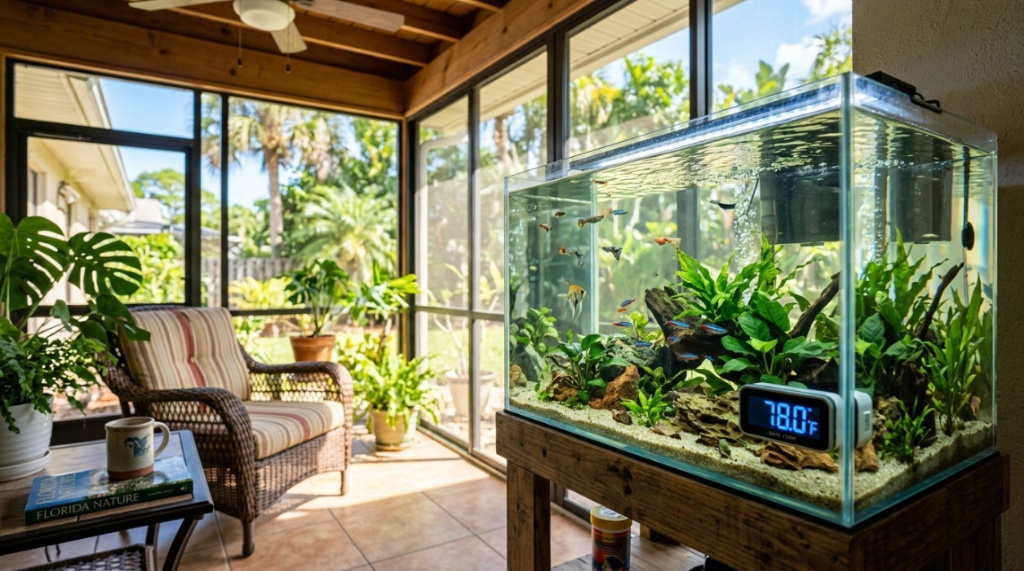
After thousands of hours of user reviews and personal testing, these are the models that consistently perform well in warm climates without breaking the bank. They all have accurate thermostats and sealed casings. Let’s skip the expensive brands that are overkill for Florida.
All of these are readily available on Amazon or in stores, usually under $25. We’ll rank them by functionality-to-price ratio, with a special focus on reliability during short cold snaps.
Review of the Tetra HT Submersible Heater
This is an excellent, budget-friendly option that comes in a 50-watt for small tanks and 100-watt for medium tanks. It features an easy-to-read dial and a direct temperature-set, which is simpler for beginners. It lacks a separate controller, but it has a solid hang-on back style and is fully submersible.
Review of the Hygger 50W/100W Aquarium Heater
Hygger is a crown jewel for value. It has an external digital temperature controller with an LED display, which is a rarity at this price point. It also has a heating indicator light and automatic shutoff. It maintains a stable temperature within 1°F, which prevents overheating in Florida’s summer.
Review of the Eheim Jager TruTemp Heater
The Eheim Jager is a bit pricier, but it’s known for its incredibly accurate thermostat and durable thick glass. It is slightly more expensive than the Hygger, but it has a shatterproof design and a warranty. It’s perfect for aquarists who want premium reliability without premium price.
Review of the Aqueon Pro Adjustable Heater
The Aqueon Pro uses a shatter-proof ceramic heater instead of glass. This is fantastic for Florida where water temperature swings can stress cheap glass. It includes a remote temperature sensor and a detachable controller with a blue digital display. Priced around $30, it offers titanium-like durability.
Review of the VIVOSUN 100W Submersible Heater
VIVOSUN offers a budget-friendly, simple design that is effectively a workhorse. This heater has no fancy controller, just a simple knob, but it is decently stable and very cheap, often finding its way under $15. It’s a good pick if you’re pairing it with an external controller.
Are There Any Hidden Costs with Cheap Heaters?
Yes, there are potential hidden costs beyond the purchase price. These include higher electricity bills if the heater’s thermostat is inaccurate and runs constantly, and replacement costs if it fails quickly due to corrosion. However, with proper sizing, these are minimal.
An inaccurate heater might cost you an extra $1-2 per month in electricity. But, a heating failure could cost you hundreds in lost fish. So, the cheapest heater is not always the most economical. Spend at least $15 to get a decent one.
Electricity Usage and Monthly Impact
Let’s do the math. A 50-watt heater running 8 hours a day uses 12 kWh per month. In Florida, the average electricity rate is 14 cents/kWh, so that’s only $1.68 a month. Even a 200-watt heater only costs $7 a month if it runs half the day. The heater is rarely your biggest electric bill.
Potential Replacement Frequency and Failures
A $10 heater might fail within 6 months, while a $25 heater lasts 3 years. Over 3 years, the $25 heater is actually cheaper. Consider the cost over the lifespan, not just the initial sticker price. In Florida’s humidity, paying slightly more for a fully sealed model is wise.
Return Policies and Warranty Terms
Check the warranty before buying. Some cheap heaters have a 1-year warranty, which is excellent. If you buy from Amazon, ensure the product is “Amazon Prime” to get easy returns. Always test the heater immediately and keep the receipt.
How to Monitor Temperature to Avoid Overheating
Do not rely solely on your heater’s built-in thermometer. Always have a separate, reliable glass or digital thermometer at the opposite end of the tank to monitor the actual water temperature. Checking this daily is the simplest way to ensure your heater isn’t faulty.
This is absolutely critical in Florida, where a warm morning can cause your heater to unnecessarily heat the water to dangerous levels if its thermostat is out of calibration. A manual check takes less than 10 seconds.
Best Thermometer Types for Florida Aquariums
You can use a simple stick-on LCD thermometer, but these are often inaccurate. It’s better to use an internal digital probe thermometer, which you can get for under $6. This gives you a precise readout to compare against your heater’s setting, alerting you to issues.
Using a Temperature Gun for Quick Checks
Consider buying a cheap infrared temperature gun (under $15) for a fast, accurate, non-contact temperature check. Just wave it over the tank glass to get a good reading. It’s also great for checking the water temperature in your mixing bucket during water changes.
The Role of Aquarium Controllers in Alarm Settings
If you use a smart controller, you can set audible alarms for when the temperature goes above 82°F or below 75°F. This gives you peace of mind, especially during Florida summer storms when you may be away from home and the power flickers.
Frequently Asked Questions
Can I use a 25W heater for a 10-gallon tank in Florida?
Yes, a 25W heater is generally sufficient for a 10-gallon tank in most of Florida, since your room temperature rarely drops below 68°F. However, keep a 50W backup for unusual cold snaps. Use the 2.5-3.0 watts per gallon rule.
Is it safe to leave a cheap heater on all year round?
Yes, it’s generally safe to leave it plugged in and running. The thermostat should prevent it from heating unnecessarily when the water is already warm. However, inspect the unit monthly for cracks or corrosion and unplug it during water changes.
How do I stop my heater from short-cycling in the summer?
Increase the wattage slightly but set the thermostat to a higher temperature (like 78°F) to prevent rapid on-off cycling. Alternatively, use a smart plug with a built-in temperature hysteresis setting to prevent the unit from turning on and off every few minutes.
Are cheaper heaters more likely to electrocute fish?
It’s possible if the glass cracks and water hits the internal wires. However, most reputable budget brands include a grounded plug or double insulation. To be extra safe, always use a GFCI outlet, which cuts power in milliseconds if any leak is detected.
What is the most energy-efficient heater type for Florida?
A submersible glass heater with a precise thermostat (like the Hygger or Eheim) is the most energy-efficient because it heats the water directly and turns off when the set point is reached. Titanium heaters heat slightly faster, but are more expensive to buy.
Should I unplug my heater during a Florida summer heatwave?
If the ambient room temperature is above 85°F, you can actually unplug the heater to prevent it from short-cycling and wearing out the thermostat. However, always monitor the water temperature thoroughly, as it may stay stable without the heater’s power.
Can I put a heater in a tank with sand substrate?
Yes, but never bury the heater in the sand. Position it vertically or horizontally a few inches above the substrate. Burying it can cause rapid heat build-up, fracturing the glass and posing a serious electrical hazard.
Conclusion: Your Next Steps to a Perfectly Heated Tank
Finding the perfect heater in Florida isn’t about buying the most expensive unit—it’s about buying the right size and features for your unique climate. Start by measuring your tank volume, use the 2.5 to 3.0 watts-per-gallon rule, and choose a fully submersible heater with a good thermostat. Skip the premium brands unless you have a huge tank.
Your next step is simple: take inventory of your current heater. Check its wattage and condition, and compare it to our recommendations. If you’re running a 200-watt heater in a 20-gallon tank, it’s time to downsize and save some money. Consider upgrading to a budget-friendly adjustable model or pairing a basic heater with a smart controller for the best results.
Don’t wait for the first cold front to hit Orlando or Miami. Take action today, buy a reliable, affordable heater, and ensure your fish stay happy, healthy, and stress-free all year long. Your fish will thank you with vibrant colors and active behavior.